



Date:
8 - 22 October 2026
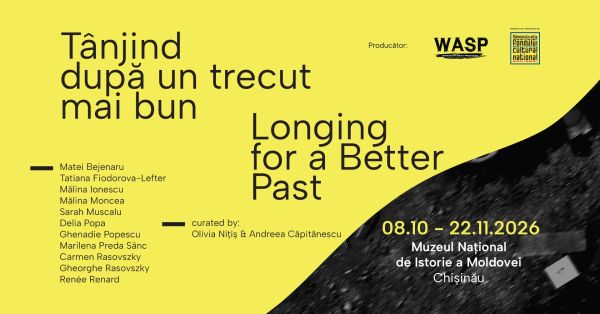
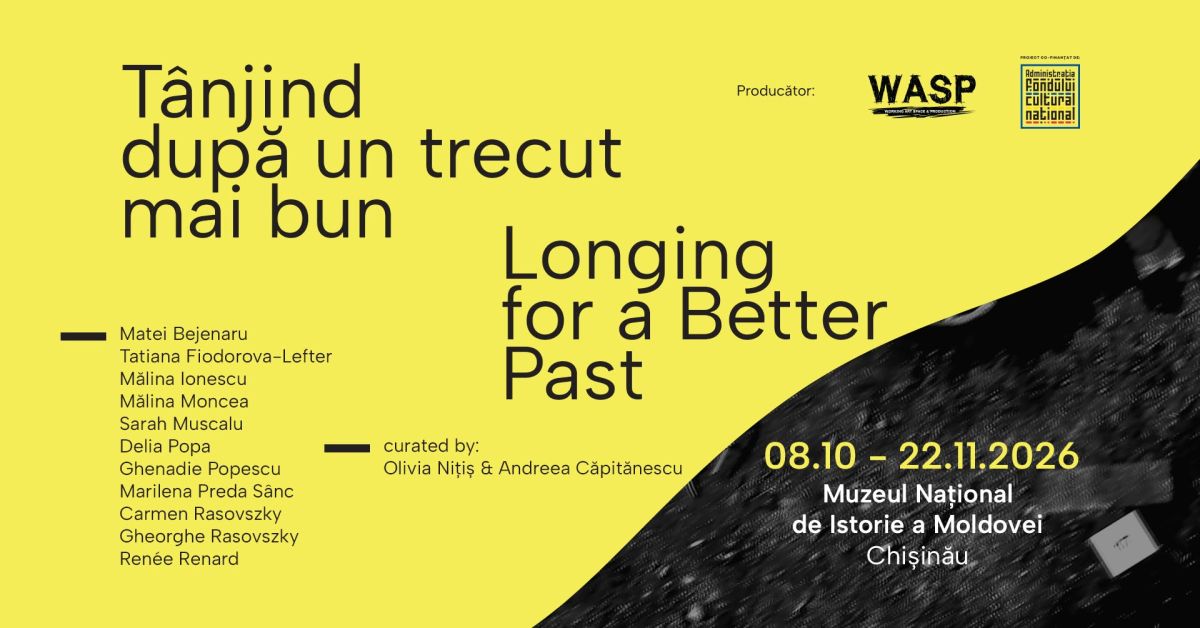
Tânjind după un trecut mai bun
Images
Information
Description
Longing for a Better Past
When you deconstruct a history, you construct another one, imperfect.
"Longing for a Better Past" is a project about rewriting history and about the fictional dimension of a past in which the one who could have been happy, later discovers that happiness as a lie. It is about the moment when the archive contradicts memory and vice versa. Political nostalgia towards socialism is the result of contradictions. It is not longing for socialism, but longing for the coherence that socialism promised and that the present cannot offer.
Starting from the idea that transition is not a rupture, but a process of ambiguous negotiation (Massino, 2019), and from the approach to history as an instrument of political power that systematically produces acts of indignity (Ypi, 2025), the project exposes the reactions of artists and women artists from Romania and the Republic of Moldova to political nostalgia towards the socialist past. Reactions are situated in the reflexive sphere, analyzing personal histories that intersect with collective ones. Nostalgia about communism launches a self-referential and self-reflexive gaze. The artwork becomes an instrument of knowledge and research, a vehicle for navigating through micro-histories, stories that may remain untold, unrecorded in history and thus lost from one generation to the next. The works are often an exercise in remembrance through others - family members, personal archives, but also archives of materials that reflect a lost era, such as the archive of Science and și Technique magazine from the communist times (the magazine is still being published).
The exhibition does not exhibit the past, but exhibits the mechanism through which the past is remembered and reconstructed to make the present bearable. The works intersect spatial memory, nostalgic dissidence, incomplete/ambiguous mourning, and reflexive nostalgia as memory of a potential future - that is, the memory of projects imagined at a certain moment in the past and that never materialized. Lea Ypi speaks of the difficult reconciliation with history through the archive as an instrument for documenting memory. However, the archive reflects the truth of the authority under which it is constituted. What the archive records consolidates the story about that political structure, marginalizing and silencing countless other points of view.
Starting from the idea that transition is not a rupture, but a process of ambiguous negotiation (Massino, 2019), and from the approach to history as an instrument of political power that systematically produces acts of indignity (Ypi, 2025), the project exposes the reactions of artists and women artists from Romania and the Republic of Moldova to political nostalgia towards the socialist past. Reactions are situated in the reflexive sphere, analyzing personal histories that intersect with collective ones. Nostalgia about communism launches a self-referential and self-reflexive gaze. The artwork becomes an instrument of knowledge and research, a vehicle for navigating through micro-histories, stories that may remain untold, unrecorded in history and thus lost from one generation to the next. The works are often an exercise in remembrance through others - family members, personal archives, but also archives of materials that reflect a lost era, such as the archive of Science and și Technique magazine from the communist times (the magazine is still being published).
The exhibition does not exhibit the past, but exhibits the mechanism through which the past is remembered and reconstructed to make the present bearable. The works intersect spatial memory, nostalgic dissidence, incomplete/ambiguous mourning, and reflexive nostalgia as memory of a potential future - that is, the memory of projects imagined at a certain moment in the past and that never materialized. Lea Ypi speaks of the difficult reconciliation with history through the archive as an instrument for documenting memory. However, the archive reflects the truth of the authority under which it is constituted. What the archive records consolidates the story about that political structure, marginalizing and silencing countless other points of view.
This is where artistic fiction intervenes. Fiction against fiction. One fiction claims to be truth, while the other assumes truth as possibility. In the project, no one directly resorts to fiction, yet all processes of reconstruction are vulnerable and contain gaps, erasures, oral histories, lived or appropriated histories that transform and are recontextualized through each artistic act. Fiction intervenes through resignification, and the works as a whole valorize subjective memories and the acceptance of the non-linear condition of history.
Round table – 8.10.2026, 17:00 / The National Museum of History of Moldova
Participants: Dr. Olivia Nițiș & Dr. Andreea Căpitănescu (curatoare), Monica Babuc, Dr. Octavian Țîcu, Vasile Munteanu, Dr. Ludmila Cojocari, Ghenadie Popescu.
Participants: Dr. Olivia Nițiș & Dr. Andreea Căpitănescu (curatoare), Monica Babuc, Dr. Octavian Țîcu, Vasile Munteanu, Dr. Ludmila Cojocari, Ghenadie Popescu.
Drawing on Svetlana Boym’s distinction between restorative and reflective nostalgia (Boym, 2001), this roundtable aims to analyze the commonalities and differences between the forms of nostalgia regarding the communist era in Romania and the Republic of Moldova. We are interested not only in how the past is remembered but also in how it is instrumentalized: what is selectively preserved and what is actively forgotten. At the same time, we aim to examine how political memory intersects with institutional approaches and the practices of contemporary artists. We will discuss the role of cultural institutions in promoting historical truth within a context marked by recurring ideological movements, as well as the role of the media and artists in articulating a critical presence within the community and the public sphere.
The exhibition is part of “Living Archives. Memory, identity and everyday gestures / Arhive vii. Memorie, identitate și gesturi cotidiene”
Cultural project co-financed by the Administration of the National Cultural Fund.
The project does not necessarily represent the official position of the Administration of the National Cultural Fund. AFCN shall not be held liable for the project’s content or any use to which the project outcome might be put. These are the sole responsibility of the beneficiary of the funding.
Cultural project co-financed by the Administration of the National Cultural Fund.
The project does not necessarily represent the official position of the Administration of the National Cultural Fund. AFCN shall not be held liable for the project’s content or any use to which the project outcome might be put. These are the sole responsibility of the beneficiary of the funding.


